Easter eggs and game secrets are among the most fascinating and powerful aspects of video games in my experience.
Stumbling onto one feels like taking a step outside the intended path and seeing the game reward our curiosity. We know many people will simply miss it, and that makes it feel special.
For a brief instant, there is a connection between the developer and the player, as we wonder: “what did it mean to you?”.
Those moments are memorable because they feel like a direct interaction between our curiosity as players and the developer’s intent.
Even more powerful are secrets that are only hinted at. Players must go out of their way to interpret clues to access the secret or easter egg. This can lead to beautiful moments of cooperation between players of the same game, all working toward a shared goal.
One video that stuck with me on this topic is the popular coverage of Shadow of the Colossus’ last secret by Jacob Geller:
I recommend you watch it to see where I am coming from, and the video is just that good anyhow.
For those who don’t want to watch it, here is the gist:
Scattered throughout the world are 4 glyphs carved in stone, each seemingly linked to one of the 16 colossi on the map. When connecting the 4 colossi locations, you get a perfect right-angled cross intersecting over a 5th location:
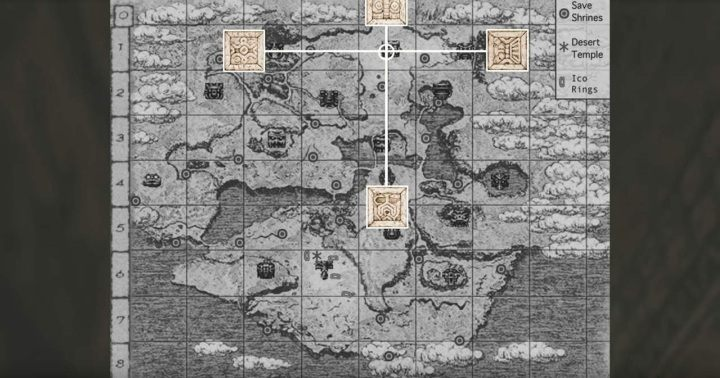
There, you can find another colossus inside a temple, and more mysteriously: a locked door that can’t be opened by any known means.
This feels intentional, and you can’t help but believe there must be a way to open this door, with something interesting waiting behind it.
For years, players (called the seekers) have searched for ways to open it, without success.
Eventually, someone managed to emulate the game, which let skilled players glitch through walls, get to impossible locations and basically rip the game apart.
There was nothing behind that door. It was meant to be shut.
Well that was disappointing…
The revelation triggered an existential crisis among the seeker community, but some kept going even though there was nothing to find.
Years later, a remake of the game was made for the PS4, and a miracle happened. The dedication of the seekers, for all these years, paid off: the door that was shut could now be opened. The seekers almost willed the secret chamber into existence and were rewarded with a throne and a sword within.
Nowadays, data-mining and emulation are commonplace. This means we can know everything that is in a game, and by subtraction, everything that is not (like the secret room that did not exist in the original version of Shadow of the Colossus).
In my own small corner of the world, I am making an open-source space exploration game (it’s called Cosmos Journeyer, check it out!), and any easter egg or secret feature I would add to the game would be trivially revealed just by looking at the code!
And that got me thinking. How do we make a secret that resists ripping the game apart? An unyielding yet solvable mystery that teases players from inside the game, and could survive for years or even decades.
This article focuses on the technical aspect of how to achieve such a thing. Leading players toward the secret is another can of worms, and I hope to cover it one day, once I learn how!
Demo Setup
We will set up a very small demo inside a 3D web environment: https://playground.babylonjs.com/#GBRNEJ
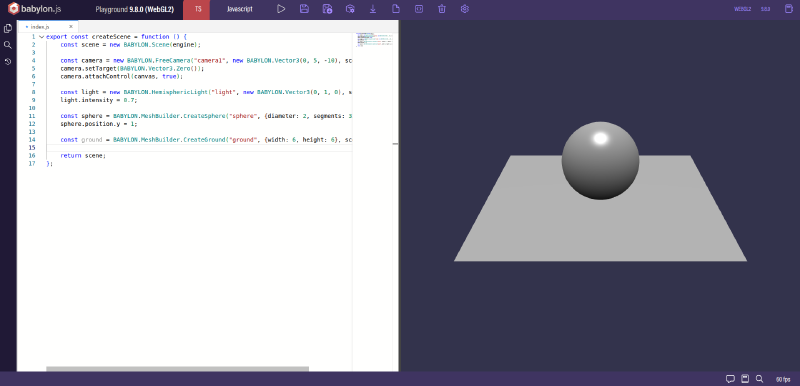
Making the secret feature
So the first step toward hiding our secret feature, is to make the secret feature in the first place: make the ball move! (Wow crazy easter egg, felt very personal).
The first thing to do is to program our easter egg inside a single function:
const secretFunction = () => {
    const scene = BABYLON.Engine.LastCreatedScene;
    scene.onBeforeRenderObservable.add(() => {
        const sphere = scene.getMeshByName("sphere");

        // translate the sphere horizontally
        sphere.position.x = Math.sin(Date.now() * 0.001) * 2;
    });
};
Basically we are adding a new behavior running every frame that will get the sphere from the scene, get the current time, and use that to make the sphere oscillate around its starting position.
And we can check, executing the function indeed triggers the secret feature: https://playground.babylonjs.com/#GBRNEJ#1
Making the secret feature secret
So how do we take this secret feature, and hide it in plain sight? That’s where cryptography comes in handy.
Here is roughly how it works:
- Get yourself a bunch of data you want to hide
- Choose an encryption key (often a sentence or a number)
- Apply some complicated algorithm to your input data (the algorithm is designed to make decryption almost impossible without the decryption key)
- Share the decryption key (often the same as the encryption key) with people you trust
So how does that apply in our case?
Preparing our feature for encryption
Starting with the data to hide: secretFunction. The issue is that a function is a complex set of instructions and data, and cryptographic algorithms work at the byte level.
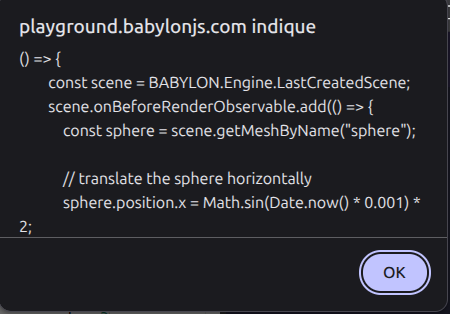
Thankfully we are using JavaScript, which has very advanced introspection capabilities, and so we can do some crazy stuff, such as dumping the source code of our function into a string at runtime:
const sourceCode = secretFunction.toString();
alert(sourceCode);
Passphrase and encryption
Now we are getting in the nitty-gritty of the topic. Let’s choose a passphrase and apply a cryptographic algorithm to our function.
Thankfully web browsers expose the SubtleCrypto API, which will let us do all that with minimal complications.
Let’s just take a moment to appreciate the reason behind the SubtleCrypto name:
Warning: This API provides a number of low-level cryptographic primitives. It’s very easy to misuse them, and the pitfalls involved can be very subtle.
Even assuming you use the basic cryptographic functions correctly, secure key management and overall security system design are extremely hard to get right, and are generally the domain of specialist security experts.
I certainly don’t identify with “specialist security experts”, so we will try our best. Just try to remember I mostly have no idea what I am doing so you should definitely check with someone else or an AI before using this code for anything serious.
So here is a helper to encrypt our code string using a passphrase with AES-256-GCM (a modern and secure encryption algorithm):
async function encryptSourceCode(sourceCode, passphrase) {
    const salt = crypto.getRandomValues(new Uint8Array(16));
    const iv = crypto.getRandomValues(new Uint8Array(12));
    const iterations = 600_000;

    const key = await deriveAesKey(passphrase, salt, iterations, ["encrypt"]);

    const textEncoder = new TextEncoder();
    const ciphertext = await crypto.subtle.encrypt(
        {
            name: "AES-GCM",
            iv,
            tagLength: 128,
        },
        key,
        textEncoder.encode(sourceCode),
    );

    return {
        algorithm: "AES-256-GCM",
        kdf: "PBKDF2-HMAC-SHA256",
        iterations,
        saltBase64: bytesToBase64(salt),
        ivBase64: bytesToBase64(iv),
        ciphertextBase64: bytesToBase64(new Uint8Array(ciphertext)),
    };
}
So what’s the meaning of all of this?
The passphrase chosen by the player is not directly usable as an AES key, so we need to transform it into one (deriveAesKey). Feeding some random salt to the key generator makes the transformation unique for this payload: two secrets using the same passphrase will have different keys. (This is probably overkill here, but that’s kinda the point of the article haha).
Then we create an AES key using the passphrase with the PBKDF2 algorithm with 600k iterations. Having that many iterations makes decryption attempts slower, discouraging players from brute-forcing their way through the secret.
Finally, we use that key with a fresh random IV (initialization vector), which makes this encryption run unique, and feed everything to AES-256-GCM. The result is an encrypted payload that in theory can only be decrypted using the passphrase.
You will notice I didn’t define deriveAesKey and bytesToBase64 so here they are:
async function deriveAesKey(
    passphrase,
    salt,
    iterations,
    usages,
) {
    const textEncoder = new TextEncoder();
    const keyMaterial = await crypto.subtle.importKey("raw", textEncoder.encode(passphrase), "PBKDF2", false, [
        "deriveKey",
    ]);

    return crypto.subtle.deriveKey(
        {
            name: "PBKDF2",
            hash: "SHA-256",
            salt,
            iterations,
        },
        keyMaterial,
        {
            name: "AES-GCM",
            length: 256,
        },
        false,
        usages,
    );
}
function bytesToBase64(bytes) {
    let binary = "";
    for (const byte of bytes) {
        binary += String.fromCharCode(byte);
    }
    return btoa(binary);
}
Here is the updated playground with the encryption helpers: https://playground.babylonjs.com/#GBRNEJ#2
So now when calling encryptSourceCode with the passphrase secret (my passwords are more secure than that, trust me) on the string we derived from secretFunction, we get something like this:
{
    "algorithm": "AES-256-GCM",
    "kdf": "PBKDF2-HMAC-SHA256",
    "iterations": 600000,
    "saltBase64": "sMsARv/gbiXyY1Vy2z4Grw==",
    "ivBase64": "xvpysEKSi1GUoQaa",
    "ciphertextBase64": "7YVg0kY/D5NN17afA5T48pckE9evKkanA6ubDbQFDBtgPCnYmLJWGBTPLbKwr3roHwrnBjPuD9JfllB2vF/cxigltbFFUpmvck1hI1R7CveAK/Lms8lEbrgRvvoinrQwdE16E6yjQ3Rl/red6OBU0KzqJiRjO63i8hJUr8Uvwfr7oZ/tySniXO/j0FYIketFyPAZcdtIVhvKDp/2RBx0XRPU3YiXzUQ+n7EnbxLcvAd+DB7nGzo/1Fgalu/J6/BhBLRwHCqcuE4tztPd+J5ofrNyW4DBm52OEhZG5HbuUrjyx2J6Zj/BCWoEm1CTK7IaicRXvOsZaBOp7LFL0cV7bNXP1JPNCcTcoVfniHq9Bbj/pNTA2XFSSa9Ug89qrghE965kaILLPJ7h01lZTm16iaEB7RQJKrt6hHaMeQJg4wWI"
}
Absolutely unreadable… perfect! Now the source code of our function exists as this encrypted string, and no one can tell what it is unless they have the key.
secret key in seconds. Prefer using an actual sentence, which will be dramatically harder to brute force.Decryption
Alright we managed to create an encrypted payload carrying our super secret feature, ready to be shipped with the code of the game.
Now we need to reverse the transformation when the player finds the correct key, as it can’t be executed while encrypted.
For this we need another crypto helper (I promise those are the last ones):
async function decryptSourceCode(
    payload,
    passphrase,
) {
    try {
        const salt = base64ToBytes(payload.saltBase64);
        const iv = base64ToBytes(payload.ivBase64);
        const ciphertext = base64ToBytes(payload.ciphertextBase64);

        const key = await deriveAesKey(passphrase, salt, payload.iterations, ["decrypt"]);

        const plaintext = await crypto.subtle.decrypt(
            {
                name: "AES-GCM",
                iv,
                tagLength: 128,
            },
            key,
            ciphertext,
        );

        const textDecoder = new TextDecoder();
        return textDecoder.decode(plaintext);
    } catch {
        return null;
    }
}
And we also need this one:
function base64ToBytes(base64) {
    const binary = atob(base64);
    return Uint8Array.from(binary, (char) => char.charCodeAt(0));
}
And here is the updated playground with all the crypto helpers: https://playground.babylonjs.com/#GBRNEJ#3
We can test it by making an encryption round trip:
const sourceCode = secretFunction.toString();
console.log(sourceCode);

const passphrase = "secret";

encryptSourceCode(sourceCode, passphrase).then((encrypted) => {
    console.log(JSON.stringify(encrypted, undefined, 4));

    return decryptSourceCode(encrypted, passphrase);
}).then((decrypted) => {
    console.log(decrypted);
})
If you look at your console output in the browser dev tools, you will see that what you get at the end is the same as your input:
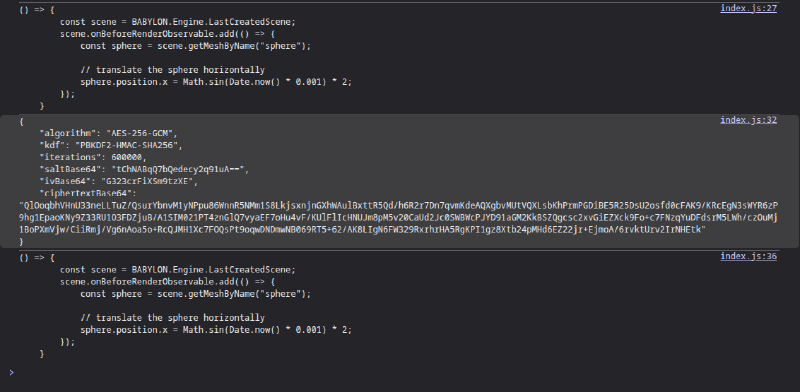
The updated playground code is available here: https://playground.babylonjs.com/#GBRNEJ#4
Alright, but what happens if we decrypt with the wrong passphrase? Well no secret for you then! Because we use GCM, decryption will fail and throw an exception. That way we don’t risk executing garbage code.
Execution
Alright we got back our function’s source code from the encryption hell it was trapped in! But how do we make it run? Right now it’s just a string…
Once again JS to the rescue! As we can convert functions into strings, we can convert strings back into function using the very dangerous eval function.
Basically eval takes a string of JavaScript source code, and just executes it. What could go wrong?
eval(username). A single malicious user can now execute any code it wants on any computer where its username appears. NOT GREAT!So let’s try it, the first thing is to stop executing our secretFunction every time to make room for our new experiment: https://playground.babylonjs.com/#GBRNEJ#5
Now, let’s resurrect our JavaScript function using eval:
eval(decrypted);
Ok nothing happened? Ah yes, we also need to call it:
const decryptedSecretFunction = eval(decrypted);
decryptedSecretFunction();
It works! We successfully decrypted our secret feature, and ran it, changing the behavior of the scene. And no one could have guessed what the feature would do!
…
What do you mean the source code of the secret feature AND the passphrase are written in plain text inside of the playground?
Ok fine, onto the last step of our journey then.
Putting it all together
And for our last trick, let’s get rid of the secret feature source code.
The first thing to do is to get the encrypted payload of our function using our chosen passphrase (I will keep using secret because I am lazy) and inject it in our code:
const superSecretPayload = {
    "algorithm": "AES-256-GCM",
    "kdf": "PBKDF2-HMAC-SHA256",
    "iterations": 600000,
    "saltBase64": "sMsARv/gbiXyY1Vy2z4Grw==",
    "ivBase64": "xvpysEKSi1GUoQaa",
    "ciphertextBase64": "7YVg0kY/D5NN17afA5T48pckE9evKkanA6ubDbQFDBtgPCnYmLJWGBTPLbKwr3roHwrnBjPuD9JfllB2vF/cxigltbFFUpmvck1hI1R7CveAK/Lms8lEbrgRvvoinrQwdE16E6yjQ3Rl/red6OBU0KzqJiRjO63i8hJUr8Uvwfr7oZ/tySniXO/j0FYIketFyPAZcdtIVhvKDp/2RBx0XRPU3YiXzUQ+n7EnbxLcvAd+DB7nGzo/1Fgalu/J6/BhBLRwHCqcuE4tztPd+J5ofrNyW4DBm52OEhZG5HbuUrjyx2J6Zj/BCWoEm1CTK7IaicRXvOsZaBOp7LFL0cV7bNXP1JPNCcTcoVfniHq9Bbj/pNTA2XFSSa9Ug89qrghE965kaILLPJ7h01lZTm16iaEB7RQJKrt6hHaMeQJg4wWI"
}
Now that the encrypted payload is written directly inside the source code, we can get rid of the encryption helpers (encryptSourceCode and bytesToBase64). Instead of calling encryptSourceCode, we pass superSecretPayload to decryptSourceCode. We also get rid of secretFunction as we will only be using its encrypted form.
To ask the user for the passphrase, we can use a simple prompt:
const passphrase = prompt("Enter passphrase");
And once that’s done, there it is: there is no trace left of our secret feature and passphrase. Even with access to the source code, no one can access our easter egg without knowing the passphrase. We did it!
Here is the final version of the code: https://playground.babylonjs.com/#GBRNEJ#20
Parting words
Well that was fun! (Well at least I had fun). We now have a blueprint to make very robust enigmas where seekers can scratch their head for years before finding the solution, without being able to cheat by reading the code or by hacking their way through it.
This still leaves a lot of room for improvement, for example the first player to find the passphrase could leak it and then there is no point in keeping the code encrypted. Let me know in the comments if you have ideas to make it better!
You can use all of this code for your own projects, and adapt it to your liking. If it comes up, attribution is always appreciated of course :)